Real-Time Email Deliverability Testing for Hospitality Brands
Test email deliverability in real time for your hospitality campaigns. Catch bounces, spam traps, and inbox placement issues before they hurt your brand reach.
Why Deliverability Matters More Than Ever in Hospitality Marketing
You sent a personalized offer to a guest who just browsed your luxury suite page. It’s timely, compelling, and meant to close the booking. But it never shows up in their inbox. It’s not even a bounce—just gone. Silence.
That’s not a minor glitch. In hospitality, where every message is a direct line to revenue and guest experience, deliverability isn’t just a backend concern. It’s the difference between a confirmed booking and a lost lead, between trust and frustration.
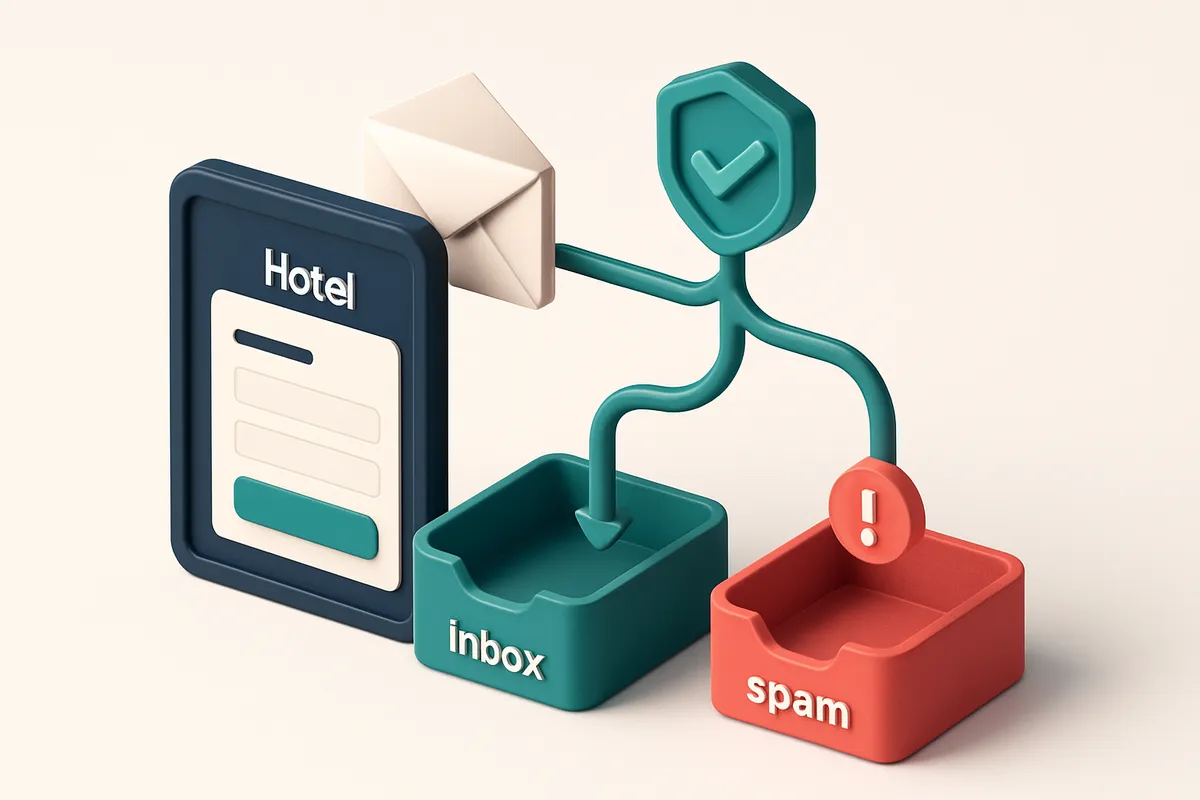
Real-time email deliverability testing for hospitality brands isn’t a technical luxury—it’s a requirement. It tells you, before you send, whether an email will land in the inbox, spam, or nowhere at all. No guesswork. No wasted sends. Just visibility into what your guests actually see.
Key takeaways
- Even a single email that fails to deliver can cost a booking and harm sender reputation.
- Deliverability impacts both revenue and guest experience in hospitality marketing.
- Real-time testing helps avoid wasted sends and keeps your brand's messaging reliable.
The Hidden Costs of Poor Email Deliverability in Hotels and Resorts
You send a booking confirmation. The guest never sees it. No reply, no review, no future booking. That’s not just a missed touchpoint — it’s lost revenue. Studies show that failed delivery can reduce conversion rates by up to 40% in critical email sequences like post-arrival follow-ups and pre-arrival check-ins.
Spam Traps Are Silent Killers
Even a single email to a spam trap can trigger a blacklist from Gmail, Outlook, or Apple Mail. These traps are not rare — they’re embedded in recycled addresses and abandoned domains used by email hygiene services. Once a sender’s IP or domain is flagged, entire campaigns can be blocked, often without warning.
MailTester’s inbox placement tests simulate real-world delivery conditions. You can check how your messages land in actual inboxes — not just spam folders — before sending to hundreds of guests. See how your brand performs today.
Bounces Don’t Start Small — They Scale
A 1% bounce rate might sound negligible. But over 10,000 emails a month, that’s 100 undeliverable messages. Each one counts toward your sender reputation score. ISPs like Gmail watch for consistent bounce patterns. If your rate climbs over time, deliverability drops — even if you're sending only to valid addresses.
That’s why real-time verification is critical. Let’s say you onboard 500 new guests a week. Without validation, 5–10% could be invalid or temporary addresses. A tool like MailTester can confirm validity instantly. Integrate our API to validate every new sign-up before it hits your platform.
Even role-based emails — like [email protected] or [email protected] — are risky. Systems treat these as low-value, high-bounce signals. They can hurt your reputation over time, especially if you send to them regularly. A catch-all detection helps you avoid this pitfall.
And disposable domains? Guests using temporary mail services (like temp-mail.org) aren’t likely to book again. Sending to them wastes sender reputation and inflates false engagement. Real-time tools flag these early.
Spamhaus and MxToolbox track known bad actors and lists. If your domain appears on one, your messages are likely blocked. The fix isn’t just better content — it’s better data. Clean, verified lists aren’t a luxury. They’re baseline hygiene.
For hotels and resorts, every email is a handshake. If it never lands, the connection fails. You don’t need more emails. You need better ones — and the data to know when they’re actually reaching someone.
Real-Time Email Deliverability Testing: What It Actually Means
You’re not just checking if an email exists when you do real-time deliverability testing — you’re simulating how an inbox will treat it, from the moment it leaves your server to the second it lands in a guest’s inbox.
Let’s be clear: this isn’t a checklist of static data points. It’s a live validation of your email’s journey through the actual infrastructure of the internet — using real SMTP connections, not just guesses.
The Full Path, Simulated
When you send an email, it travels through domain checks, DNS records, SPF, DKIM, DMARC, and even the spam reputation of your sender IP and domain. Real-time testing doesn’t skip any of those steps.
It checks MX records to confirm mail servers are active, validates DNS settings to prevent delivery failure, and probes the real-time reputation of the sending infrastructure. This means identifying if your email is likely to be flagged by major providers like Gmail, Outlook, or Yahoo.
It’s not just about catching typos or invalid domains. A real-time test tells you whether your message will land in the inbox — or the spam folder — before it’s ever sent.
How It Differs from Static Checks
Static email validation only confirms existence or format. It can’t tell you if a valid inbox will actually receive your message with good placement.
For hospitality brands, that difference matters. A guest with a valid email might still miss a booking confirmation if the server thinks it’s spam. That’s why live testing — with real SMTP handshakes — is the only way to catch that risk early.
It’s not about speed alone. It’s about accuracy. Testing through real, up-to-date connections gives results that reflect actual inbox placement, not just theoretical validation.
MailTester’s inbox placement test uses actual mail servers to simulate delivery across platforms, helping you spot red flags before they cost you guest trust. It’s the closest thing to sending a test email for your campaign with no risk.
You can run this test as part of a bulk verification workflow, through our real-time API, or even use our inbox placement tool to audit your outbound flow.
And yes, it works with your existing tools. If you use HubSpot or Klaviyo, you can connect through our integrations and test your lists before campaign sends.
It’s not magic. It’s just a more accurate picture of what your emails will face out there — in the real world, not just in theory.
The Real-Time Verification API: How It Works in Practice
Let’s say you’re a hotel or restaurant chain. A guest books a room, and you ask for their email. Right then, you don’t want to wait for a bounce or a failed delivery later. You want to know if that email will actually land in their inbox.
How It Fits Into Your Workflow
You already integrate with tools like HubSpot, Klaviyo, or your booking engine. Now, add MailTester’s real-time verification API directly into that pipeline. No extra tools. No delays.
- Trigger the API when a new email is submitted. As soon as a guest enters their email during booking, checkout, or newsletter sign-up, your system sends it to MailTester’s API endpoint.
- MailTester checks syntax, domain status, and mail server response. It validates the email format, checks DNS records (MX, SPF, DKIM), and probes whether the receiving server will accept mail—before you send a single message.
- Get a verdict in under 500 milliseconds. The API returns one of four verdicts: valid, invalid, risky, or catch-all. Each outcome tells you exactly what to do next.
- Act immediately based on the result. Valid emails go straight into your campaign or CRM. Risky emails get flagged for review. Catch-all or invalid ones can be skipped or corrected on the spot.
- Log and track results for analysis. You can store verification outcomes to monitor trends, spot issues in regional booking flows, or improve guest data quality over time.
This isn’t just checking syntax. It’s testing real-world deliverability—because a high-volume email campaign fails if even 10% of addresses bounce.
What Each Verdict Actually Means
Understanding the outcome is just as important as getting it fast. Here’s what you’re seeing:
- Valid: Email is syntactically correct, domain exists, and accepts messages. Safe to send to.
- Invalid: Format issue, non-existent domain, or known blocklist. Don’t send.
- Risky: Accepts mail, but may be in a high-bounce or high-complaint tier. Use with caution—consider double opt-in.
- Catch-all: Server accepts all addresses, but sends to unknown recipients silently. Often linked to role accounts or disposable domains. Avoid for personal marketing.
These distinctions matter—because a SMTP standard defines how servers respond, and some domains are built to accept any address. That’s not a real user.
You’re not just cleaning data. You’re protecting sender reputation, reducing bounce rates, and improving inbox placement. The result? Better guest communication, fewer wasted sends, and higher engagement.
Ready to test it? Try the API with your first 100 verifications—free and no expiration. See how it works with real-time delivery testing.
Key Deliverability Signals Your Hospitality Emails Must Pass
Let’s be clear: even the most beautifully crafted email campaign fails if it never reaches the inbox. For hospitality brands, where timing and personalization matter, deliverability isn’t optional—it’s foundational.
Authentication: Your Digital Passport
Your email is only as trustworthy as the records attached to it. SPF, DKIM, and DMARC aren’t checkboxes on a setup form—they’re the backbone of sender trust.
- SPF tells receiving servers which mail servers are authorized to send on your domain.
- DKIM signs your messages cryptographically, so receivers can verify they weren’t altered in transit.
- DMARC gives you control: it defines what happens when messages fail SPF or DKIM checks.
Without proper alignment across all three, your emails get flagged as suspicious—even if they’re perfectly harmless. The good news? You can test this in real time before sending. MailTester’s inbox placement tool checks whether your authentication is set up correctly and how aggressively ISPs react to it.
Reputation: It’s Built, Not Bought
Even if your authentication is perfect, your domain and IP reputation determine whether your email is opened or blocked.
- New domains face higher scrutiny. ISPs don’t trust them until they see consistent, positive behavior over time.
- IP reputation isn’t about a single campaign. It’s shaped by sending volume, message content, engagement rates, and complaint frequency.
- High bounce rates or low opens signal poor list hygiene to gatekeepers like Gmail and Outlook.
That’s why you need real-time validation. Let’s say you’re testing a campaign for a luxury resort. A single bounce from a disposable email can skew your sender score. MailTester’s bulk verification checks thousands of addresses instantly—flagging invalid, catch-all, and risky addresses before they hurt your deliverability.
For ongoing campaigns, use MailTester’s real-time verification API to clean your data at point of capture. It’s not just about removing bad addresses—it’s about building a reliable sender profile, one clean email at a time.
Deliverability isn’t a one-time check. It’s a continuous process of verification, consistency, and monitoring.
And if you’re building a list from scratch? Use MailTester’s email finder to source valid, targeted contacts—verified at the moment of discovery.
MailTester’s Inbox-Placement Testing: What You Can’t Trust Without
You don’t need to guess whether your hotel newsletter or vacation package blast lands in the inbox. MailTester’s inbox-placement testing gives you real, actionable data before you hit send. It’s not just a simulation—it’s delivery to actual Gmail, Outlook, Apple Mail, and Yahoo inboxes, from live IP addresses. This mimics how your email will be treated in the wild.
Let’s be clear: many tools tell you your message "passed" spam checks. But that doesn’t mean it lands in the inbox. A high spam score doesn’t always mean bounce—sometimes it just gets buried. MailTester shows you the real result: inbox placement rate, and a risk score based on how mailbox providers are filtering messages today.
Test before you send—especially with big campaigns or new domains
You’re not just sending an email. You’re sending a brand promise. If it ends up in a junk folder at a critical moment, that promise fails. That’s why you should audit every campaign before launch—especially mass promotions or when using a new domain for the first time.
Domain reputation and sending practices matter. A newly registered domain without a history of deliverability gets extra scrutiny. If you’ve ever seen a sudden drop in engagement spikes on launch day, it’s likely because the message hit the filters before your audience even saw it. MailTester helps catch that before it happens.
It’s not enough to check SPF or DKIM. These verify identity, not delivery. Real-time inbox-placement testing checks how mail actually lands. You’ll see if your message is likely to go straight to the Junk folder, or worse—get silently blocked.
You can test with a small sample or with your entire list. Either way, the results reflect current filtering behavior. Mailbox providers like Gmail and Yahoo continuously adjust their algorithms. What worked last month might not work today. That’s why testing with a live IP under real conditions is non-negotiable.
Use this to compare campaigns. See how changes to subject lines, sender name, or content layout affect inbox placement. It’s not just about avoiding spam. It’s about building trust—your message belongs in the inbox, not the trash.
For hospitality brands managing multiple campaigns, seasonality shifts, and global audiences, inbox placement isn’t a luxury. It’s your first point of contact with a guest. You can’t afford to get it wrong.
You can run inbox-placement tests anytime—before a big campaign, before onboarding new users, or auditing an entire list. Learn more at MailTester’s inbox-placement testing page.
How Real-Time Testing Prevents Brand Damage in Hospitality
You don’t want a guest checking their inbox only to see a failure notification from your hotel’s booking confirmation. That’s not just an inconveniency—it’s a breach of trust. Real-time email deliverability testing catches those errors before they happen, ensuring your messages land in the inbox, not the junk folder or the void.
Stopping the Bad Signals Before They Start
Let’s be honest: sending to disposable emails or role accounts (like [email protected] or [email protected]) doesn’t help your sender reputation. These addresses often have no real engagement, and repeated sends to them can trigger spam filters. Real-time verification filters out these risky addresses instantly, so you're only sending to accounts with real intent.
It's not just about preventing a bounce. It’s about preserving your reputation. Email providers like Gmail and Outlook use engagement patterns—opens, replies, forwards—to assess sender trustworthiness. Sending to dead ends repeatedly signals you’re not a reliable sender. That’s why tools that clean your list before big sends matter.
Protecting Your Inbox Placement Before Scale
Imagine launching a campaign to 100,000 past guests. If even 1% of that list is invalid or risky, you’re asking for trouble. High bounce rates from a large send spike can trigger blacklisting or aggressive filtering, even if your content is flawless. Real-time testing lets you verify and clean your list at scale, long before you hit send.
You’re not just cleaning data—you’re protecting your deliverability. According to Return Path’s Email Sender & Provider Report, senders with consistently low bounce rates are more likely to avoid spam folders. It’s a direct link between list hygiene and inbox placement.
Let’s say you're running a seasonal campaign. You can use real-time verification through the MailTester API to validate emails as they’re added to your system, or use bulk verification to audit your existing database. Either way, you’re not guessing—your data is checked against real-time delivery criteria, including SPF, DKIM, and MX checks.
Even better, if you’re building a new mailing list, you can use the MailTester email finder to locate real guest emails from public sources, then verify them before ever sending. It keeps your list clean, your reputation safe, and your guest experience seamless.
Integrating Real-Time Testing into Your Hospitality Workflow
Set Up Continuous Verification at the Source
Let’s get your email verification working the moment a guest signs up. Real-time deliverability testing isn’t a one-off check — it’s part of the flow. Connect MailTester to your CRM or email platform. You can sync with HubSpot, Salesforce, Mailchimp, or Klaviyo via our native integrations. Once connected, every new email entering your system gets tested instantly. With 100 free verifications to start, this is low-risk and high-reward from day one. You’re not just cleaning data — you’re preventing bounces, protecting sender reputation, and improving inbox placement before a single email leaves your server.
Run the Test Before the Email Goes Out
Now, automate the verification step. Set up auto-verification on new guest sign-ups or newsletter subscriptions. That means every email is checked against real-time feedback from receiving servers — not just syntax or domain validity, but actual deliverability potential. This stops invalid or risky addresses from entering your list. It also catches disposable domains, role accounts (like info@ or support@), and catch-all setups early. These are common in hospitality sign-up flows and can poison your sender reputation. If a guest signs up with an email that’s rejected by major providers, you’ll know before you send. That’s how you keep your deliverability rate above 90% — a level consistently seen as strong in industry benchmarks from sources like the Messaging, Malware, and Mobile Anti-Abuse Working Group (M3AAWG).
- Connect MailTester to your CRM or email platform. Choose from our integrations with HubSpot, Salesforce, Mailchimp, Klaviyo, and others. Setup takes under 10 minutes.
- Enable real-time verification on new subscriptions. When a guest signs up, MailTester checks the email instantly. You’ll get a verdict: valid, invalid, catch-all, or risky — all in seconds.
- Use the in-app AI assistant to interpret results. If an email is flagged as risky, the AI explains why — for example, “This domain uses greylisting” or “This address is a role account.” It gives you actionable advice, like pausing sends or adding a double opt-in.
You’re not just reducing bounces. You’re preventing inbox placement issues before they start. For hospitality brands, that means your welcome email doesn’t get flagged as spam. It lands in the inbox, not the junk folder. Real-time testing isn’t a luxury — it’s a baseline for reliable communication. With MailTester, you can verify at scale using our real-time verification API or clean bulk lists with bulk verification. And if you need to find a guest’s email after they’ve booked, our email finder can help. Just plug in a name and domain, and we’ll return the likely match. Let’s be honest: no system is foolproof. But with real-time feedback built into your workflow, you’re far ahead of brands still using manual checks or outdated data.
Verdicts Explained: What 'Valid', 'Risky', and 'Catch-All' Mean
When you’re sending to a hospitality list, you don’t want to guess. You need clear signals. Let’s break down what each email verification verdict actually means—no jargon, no guesswork.
Understanding the Verdicts
Each result from a real-time verification tells you something about the email’s ability to receive messages. Here’s what they mean in practice.
| Verdict | What It Means | Expected Delivery Outcome | Recommended Action |
|---|---|---|---|
| Valid | Email address exists and the server accepts messages. No immediate red flags. | High likelihood of inbox delivery. | Send as expected. Prioritize these for campaigns. |
| Risky | Address is syntactically correct, but delivery may be delayed or blocked due to temporary issues (e.g. server outage) or high spam score. | May bounce, go to spam, or be throttled. | Test deliverability before sending. Avoid high-volume blasts. |
| Catch-all | Server accepts all emails regardless of validity. Common with role-based addresses (e.g. info@, sales@) or shared domains. | High risk of bouncing or being flagged as spam. Often a sign of low signal-to-noise. | Exercise caution. Verify if the recipient is truly the intended contact. |
The distinction matters. A catch-all might “accept” your message, but it doesn’t mean the user sees it. It’s a dead end, and it can hurt your sender reputation.
These verdicts are based on real-time SMTP checks, MX lookups, and behavior analysis—like whether a server rejects invalid addresses or forwards them silently. The standards come from RFC 5321 and RFC 5322, the foundational documents for email protocols.
Many tools claim to verify email lists, but few give you this level of signal. Unlike providers that rely on static databases or incomplete validation, MailTester checks each address live against the receiving server. That’s why accuracy is consistently above 98.9% for real-time verification.
Try it yourself: Test your hospitality list with real-time bulk verification. See which addresses are worth sending to, and which ones drain deliverability.
Why Manual Testing Isn’t Enough for Hospitality Email Flows
Let’s be honest: checking a handful of test emails manually won’t catch the real problems in your guest communication pipeline.
Speed matters—every second counts
Guest check-ins, booking confirmations, and post-stay surveys aren’t just routine. They’re time-sensitive. A delay or misdelivery can ruin the guest experience before they even arrive—or worse, after they leave.
When you're sending hundreds of emails per day, even a small drop in deliverability can compound fast. One invalid address in a 10,000-list send might seem trivial—but it can spike your bounce rate by 5% or more, especially if those bounces trigger rate-limiting or reputation alerts with inbox providers.
And here’s the hard truth: most email systems don’t flag invalid addresses until a bounce happens. By then, it’s too late for real-time correction.
Manual checks miss the scale of the problem
Reviewing addresses one by one? That’s not scalable, and it’s error-prone. Even a simple typo like “@hotmial.com” or a missing domain extension can slip through.
Real-time email deliverability testing catches these issues before they reach the inbox—not after. It verifies syntax, domain validity, and mailbox responsiveness on the fly. That means fewer bounces, fewer deliverability flags, and a cleaner sender reputation over time.
Without automation, you’re guessing. With real-time verification, you’re acting—on every email, every time.
Imagine catching a catch-all domain (or a disposable one) before it even makes it into your campaign. Or spotting a role account like “[email protected]” that likely won’t be read. Tools like MailTester’s inbox placement testing simulate real recipient behavior across major providers, so you know if your message will land in the inbox—or the spam folder.
Automated verification also integrates with your existing workflows. You can plug MailTester’s real-time verification API directly into your booking system or CRM. No manual checks. No delays. Just clean, valid data from the start.
It’s not about replacing human judgment. It’s about giving it power at scale.
For hospitality brands managing high-volume, time-sensitive email streams, real-time testing isn't a luxury. It’s what keeps guests informed, trusted, and engaged.
Conclusion: Deliverability Is Part of Your Guest Experience
When a guest books a stay, they expect a confirmation email. A failed delivery breaks trust before the stay even begins.
Real-time email deliverability testing confirms your message reaches the inbox—on time, every time. No more surprises, no more missed opportunities.
With MailTester, you verify, test, and deliver with confidence at scale—ensuring every message lands where it should.
Keep reading
- Deliverability monitoring, metrics and reporting (complete guide)
- Automated Email List Validation with Catch-All Domain Detection
- Email Validation for Automated Mortgage Application Confirmation Emails
- Email Deliverability Analytics for Automotive Industry B2B Campaigns
- Automated Email Validation for Event Reminder Systems in 2026
Ready to put this into practice? MailTester verifies emails with 98.9% accuracy — start with 100 free verifications.
Frequently asked questions
What is real-time email deliverability testing?
It’s testing email delivery potential using live SMTP connections and inbox simulation to predict whether messages will land in the inbox or spam folder.
How does MailTester test deliverability in real time?
It uses a real-time API to verify addresses and simulate delivery across major mail providers using real IP addresses and inbox placement checks.
Why is deliverability testing critical for hotel marketing?
A failed email can miss a booking confirmation, reduce guest satisfaction, or harm sender reputation when large lists include bounces.
Can real-time testing reduce spam complaints?
Yes—by filtering invalid and role accounts before sending, you reduce the risk of triggering spam filters and complaints.
How does inbox placement testing work?
It simulates sending to real inboxes across Gmail, Outlook, Apple Mail, and Yahoo to measure the likelihood of landing in the inbox versus spam.
What’s the difference between email verification and deliverability testing?
Verification checks if an address exists; deliverability testing predicts whether the email will reach the inbox and avoid spam.
Does MailTester integrate with platforms like Mailchimp or Klaviyo?
Yes—MailTester integrates directly with Mailchimp, HubSpot, Klaviyo, and SendGrid to automate verification and testing in workflow pipelines.
How accurate is MailTester’s delivery testing?
MailTester’s verification accuracy is 98.9%, based on real-world comparisons with confirmed delivery outcomes across major email providers.
What types of email addresses does MailTester flag as risky?
It flags disposable domains, role accounts (e.g., info@, sales@), and catch-all setups that often receive low engagement or trigger spam filters.
Do purchased credits on MailTester expire?
No—once purchased, credits never expire, allowing you to use them at any time without urgency or waste.
How many free verifications do you get with MailTester?
You get 100 free verifications to start, with no time limit or expiration on purchased credits.
Can I test deliverability for a new domain?
Yes—MailTester's inbox placement testing helps assess new domains before large-scale sends, reducing risk of reputational damage.